

Ten days ago we wrote that the RTX 5090 had drifted out of gamers’ reach, at about 3.5 times its MSRP. It has gone a step further since. The last in-stock RTX 5090 our Market Watch found at a US shop was $6,995 on October 11, and it has not seen one since. Right now the card is almost impossible to buy, even if you are willing to pay dearly for it. That made me look back at how we got here.
The Problem Today
Somewhere right now, a guy has just brought home a brand new RTX 5080 that he paid $2,000 for. That is not an exaggeration: our RTX 5080 Market Watch page shows US shops averaging about $1,980 over the last four days, for a card that launched at $999. He launches the game he bought it for and gets 30 FPS. I can’t even say the game is too demanding. It’s a regular, run-of-the-mill AAA game that, in my opinion, should run better on far cheaper cards, and as far as I can tell its optimization is fine. The problem is that the company telling players how much they have to pay, and what and how they’re supposed to play, has completely lost touch with reality.
Around the time the first RTX series came out, everything changed. We were promised technologies that would change gaming and make it for everyone. They weren’t lying: gaming really did change, just for the worse. Every six months there’s a new technology that makes PC gaming even less optimized. Prices are set as if hundreds of millions of PC players can afford a new GPU for thousands of dollars every year. And these cards often can’t properly run new games that look worse than what we played ten years ago.
So I want to answer three questions. How did Nvidia come to dominate gaming? Why does it no longer seem to care about the experience of its own customers? And why is the CEO of its only competitor a relative of Jensen Huang?
Born from a Near-Death Experience
In 1993, Huang and two engineers founded a company to make graphics cards for PC games. Within its first three years, his decisions left the company with exactly one month of money. Nvidia built its first chip its own way, the way it thought was right. Then Microsoft released DirectX and set the rules all PC games had to follow, and Nvidia’s card didn’t fit them. The product the company had sunk all its money into became useless overnight.
The lesson Huang took was that depending on other people’s standards is dangerous. In the future, he wanted to be the one setting them.
At that point Nvidia had one big client, SEGA, which had ordered a chip for its next console. Huang flew to Japan to meet Shoichiro Irimajiri, the head of SEGA of America, a man who had previously designed engines for motorcycles and Formula One cars at Honda. Huang told him honestly that they had chosen the wrong approach, that the chip wouldn’t work, and that the contract should be cancelled. Then he asked SEGA to pay $5 million anyway, because otherwise the company would die.
Imagine walking into a client’s office, telling them you completely messed up, and asking to be paid for it. SEGA agreed, and later sold its stake in Nvidia for $15 million, tripling its investment. Had SEGA held on to it, that stake would be worth over a trillion dollars today. This business model, making a flawed product and still demanding serious money for it, is exactly the one Huang used when he launched the RTX series.

The Comeback and the Competition
With that $5 million, Nvidia had exactly one shot: the Riva 128, built strictly to Microsoft’s rules. It sold over a million units in four months. The GeForce 256 followed, marketed as the “world’s first GPU,” a term Nvidia essentially invented and one we still use today. Until then, the CPU calculated all the geometry of the game world, and now the graphics card took over that job.
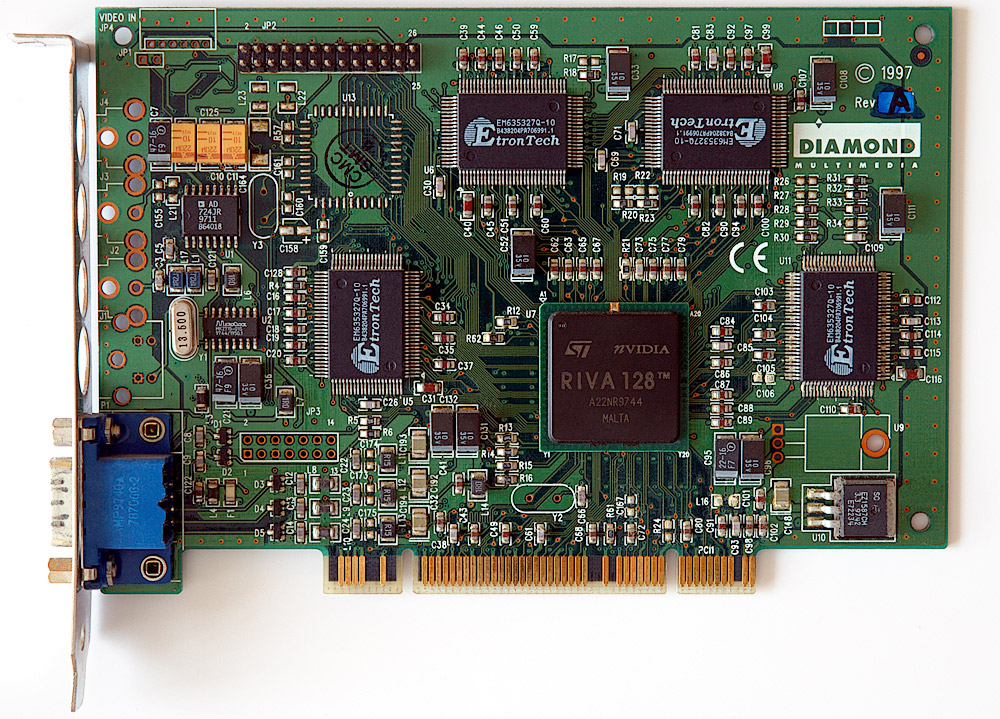

But Nvidia was far from the top dog. That was 3dfx, whose Voodoo was a whole generation’s first graphics card and which held 85% of the market in 1997. GeForce started taking its customers, and by the end of 2000 Nvidia bought whatever was left of 3dfx. Only one rival remained: Canada’s ATI, which AMD later bought.
First Lie: The Benchmark Scandal
Huang clearly liked working without competitors, but that trick didn’t work on ATI. So in 2003, Nvidia lied to gamers for the first time.
With the GeForce FX generation, Nvidia found itself playing catch-up, because ATI’s Radeons were simply faster. Buyers then, just like now, looked at benchmarks, and the most popular was 3DMark, which runs the same scenes on every card and gives a score. Suddenly the new GeForces started scoring suspiciously high.
3DMark’s developers checked Nvidia’s drivers and found eight mechanisms that detected that 3DMark specifically was running. The moment the driver saw it, the GPU rendered less than the test asked for and racked up fake points. After a patch hid the test from the driver, Nvidia’s flagship lost almost a quarter of its score. The Radeon lost less than two percent.
The CUDA Gamble: Gamers Pay for the Future
Three years later, in 2006, Huang bet the entire company. He decided that every Nvidia gaming card would also be a little scientific computer. The technology, CUDA, let you use a graphics card for any kind of calculation, from weather to medicine. Gamers didn’t need it, and nobody wanted to pay extra for a technology they didn’t need. Does that sound familiar? It was built into every GeForce anyway, from the most expensive to the cheapest.
According to Huang himself, the cost of making the cards went up by half and ate all the company’s profit. Nvidia, worth around seven or eight billion dollars at the time, dropped to about one and a half. Part of that drop came from the 2008 financial crisis, but Huang ties it specifically to CUDA. For years almost nobody used it. Investors were furious, and every quarter Huang had more bad news for them. In one interview he flatly admitted that he understood from the very beginning that gamers would carry this burden and pay for it.
For six years CUDA sat in every GeForce as dead weight, even though for gaming those years were probably Nvidia’s best. The first CUDA card, the 8800 GTX, came out at the end of 2006 and is still one of the best graphics cards in history for many people. For years it ran everything you threw at it, including Crysis, which was then the test of whether your computer had the right to be called a gaming PC.
Playing Dirty Against Rivals
In this period, Nvidia also used its position against competitors:
- PhysX: In 2008, Nvidia bought Ageia, a company that made separate boards for game physics. A couple of years later, Mafia 2 showed how realistic and fun physics in games could be. Some players put a Radeon in their PC for graphics and an old GeForce next to it just for physics. In 2009, Nvidia released drivers that turned PhysX off the moment they detected an ATI card in the system, even if the GeForce you paid for was sitting right there.
- Crysis 2 tessellation: In 2011, a patch came out for Crysis 2, a game Nvidia was promoting. It added tessellation, a technology that adds detail to objects, and Nvidia cards were stronger at it. Journalists broke down a frame and found that the most detailed object in the scene was an ordinary concrete road barrier. Under the level, beneath all the asphalt, a whole ocean was being rendered that players never saw. No direct evidence ever showed that Crytek did this because Nvidia asked, but all that extra work hit the competitor’s cards hardest.
2012: The Accident That Changed Everything
Things could have gone on like that, with gamers overpaying for a technology they didn’t need and developers making games harder to run on rival cards. But in 2012, someone finally decided to see what CUDA could do.
In Toronto, a student named Alex Krizhevsky sat in his room at his parents’ house. He had two GTX 580s at around $500 each, regular gaming cards. He used CUDA to write a neural network that learned to recognize what’s in a photo, and trained it on those cards for five days. At a worldwide image recognition competition, he got 15% errors. Second place got 26%.
That gap was so huge that the entire world of artificial intelligence switched to Nvidia graphics cards. His academic advisor, Geoffrey Hinton, later received the Nobel Prize. While everyone else was buying cards to play games, this guy used the technology nobody cared about. That is exactly what showed Nvidia was no longer going to be about games.
RTX: The Same Trick, Nearly Twice the Price
In August 2018, Huang walked out in his leather jacket and said they had been working on this for ten years. The new generation was called RTX: real-time ray tracing, with lighting, shadows and reflections calculated almost like in the movies. We didn’t know that these technologies, supposedly aimed at gamers, were the foundation for Nvidia becoming the biggest AI company in the world.
Inside those cards were Tensor Cores, one reason RTX cards cost a few hundred dollars more than their predecessors. They are separate blocks that are very fast at one thing: running neural networks. Nvidia designed them for a completely different market and had put them in server chips costing thousands of dollars a year earlier. Games didn’t need them, so Nvidia found them a job: DLSS.
So one technology you didn’t ask for (ray tracing) eats your frames, and another you didn’t ask for (DLSS) gives them back. You pay for both.
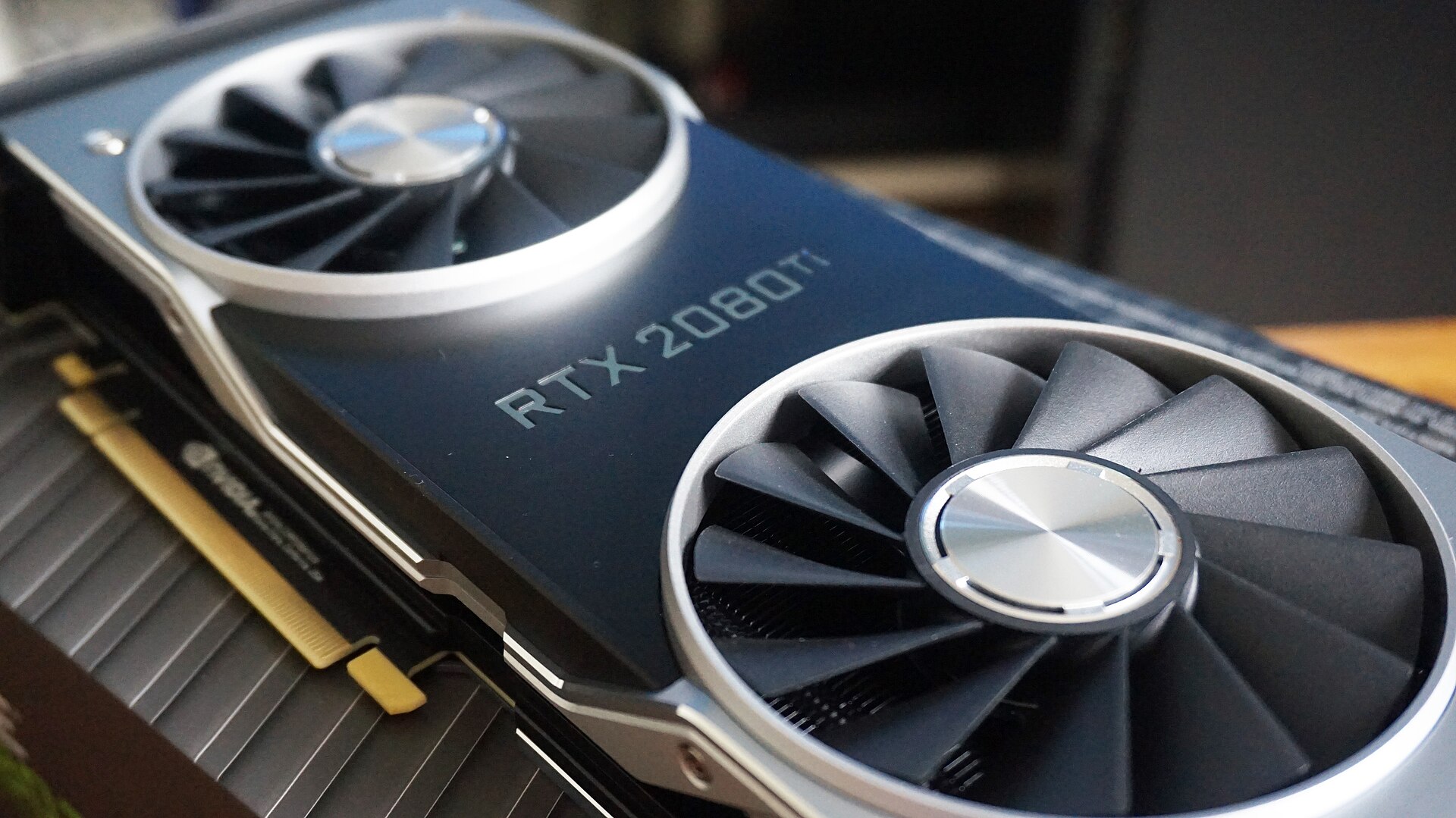

Gamers paid for CUDA in every GeForce for six years. Nvidia did the same thing a second time, only openly and at nearly twice the price. Every RTX sold is one more neural-network machine in one more home. Students, developers and researchers learn to work with neural networks on gaming cards because server cards are far out of their budget. That’s why it was critical for Nvidia that everyone talked about ray tracing and DLSS. Without them, Tensor Cores in a gaming card would look like what they are: an expensive add-on the gamer pays for so the company can build its future.
The Relative Across the Table
In 2020, it became clear how important all this was. Nvidia’s only real competitor was AMD, which had bought ATI back in 2006. I’d love to tell you that years earlier Huang feared it would catch up, so he hired the Hong Kong mafia to politely ask AMD’s CEO to resign, and in 2014 his relative took over. I embellished the mafia part, maybe just a little. But the fact that the CEOs of two competing companies are relatives is completely true. Huang’s mother is the sister of Lisa Su’s grandfather.
Under Su’s leadership, AMD caught up to Nvidia in 2020 for the first time in many years. The new Radeons ran almost neck and neck with RTX cards in regular games and lost only in ray tracing and DLSS, the very things that justified the existence of those Tensor Cores.
My Conclusion
Nvidia has behaved the same way for 20 years. I don’t think it degraded or got greedier. It is following the laws of capitalism and an irreversible technological revolution. The pattern runs through the whole story:
- Nvidia builds technology for its own long-term goals.
- It bundles that technology into gaming cards and has gamers pay for it.
- It then finds a way to justify the technology to gamers.
And because of that revolution, we may go in to a war with the Terminators in just a decade or two!