

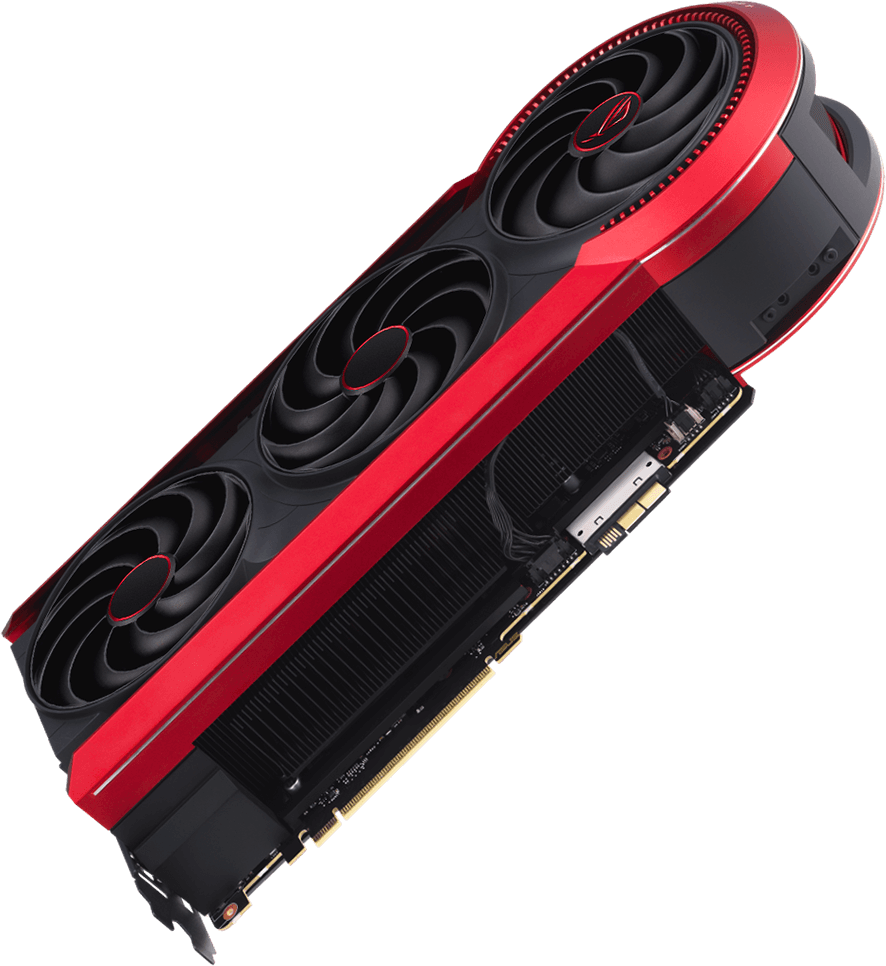
ASUS’s ROG Matrix Platinum 30th Anniversary Edition is the most expensive RTX 5090 listing in our US data. On October 11, two marketplace sellers on Amazon US offered it as new at $9,899 and $9,999.99, close to five times the $1,999 launch MSRP of the GPU it is built on. ASUS says it is a limited edition with liquid metal on the GPU die, a four-fan cooler and a full-copper vapor chamber.
In two months the US RTX 5090 went from a $4,830 median to almost $7,000
Our US data starts on August 19, when the daily median price of an RTX 5090 was $4,830. On October 11 the cheapest card in stock cost almost $7,000, which is 44.8 percent above that median and 3.5 times the launch MSRP. Most of the rise came in one step in mid-September, when Amazon’s readings went from $5,689.95 and $5,499.99 on September 9 and 10 to $6,395 on September 15. The 90-day median is $4,900 across 45 captures, 2.45 times the MSRP, and the tracker’s 30-day change is +38.7 percent. Germany, France and the Netherlands moved the same way, by 49, 38 and 35 percent since August 19, with VAT included.
RTX 5090 US daily median price since August 19, against its $1,999 launch MSRP
- GeForce RTX 5090, US daily median
How the points are made
Each point is the median of the US new-retail prices captured that day, tax excluded, from one to four captures. A reading from June 30 is left out because the next one comes 50 days later. The dips on September 30 and October 6 come from days when Micro Center and Best Buy were captured.
The cheapest card is a Gigabyte Gaming OC from a marketplace seller on Amazon. Best Buy, Newegg and B&H had none in stock that day, so the only US price we could confirm came from a reseller. The early figures are thin: three of the four August 19 starting points, all in Europe, are single captures.
A company running AI can afford a GPU at almost $7,000, and a gamer cannot
The RTX 5090 has two kinds of buyers now, and they do not play the same game. One is a company that runs AI models, renders or simulates on its own hardware. The card earns money for that buyer, so its price is weighed against the value of the work, and almost $7,000 is a line item. The other is a gamer who wants more frames per second and pays out of a salary. When the price climbs from $4,830 to almost $7,000, the first buyer keeps buying and the second one drops out.
Supply does not stretch to cover both. NVIDIA and the memory makers send their capacity where the money is, as the filings below show, so the cards that exist go to whoever pays the most, and that is not the gamer. The little players, the people who wanted the best frame rate and could stretch to a flagship, are left behind.
The 5090 was sold to gamers, but less than 1% of the surveyed Steam systems have one
NVIDIA’s own page says the RTX 5090 is “the most powerful GeForce GPU ever made, bringing game-changing capabilities to gamers and creators”, and the same page advertises LLM performance in tools such as LM Studio and AnythingLLM. The card was built for two audiences that pay for different things: a gamer buys frame rates, and someone running a local model buys the 32 GB.
Steam’s September survey shows what surveyed gaming PCs hold. The RTX 5090 is in 0.40 percent of surveyed systems, down from 0.43 percent in May, while the RTX 5070 leads at 6.15 percent and the RTX 5060 and RTX 5060 Ti follow at 4.40 and 4.06 percent. Over the five months in the chart the RTX 5070 nearly doubled its share, from 3.09 to 6.15 percent, and the RTX 5090 stayed between 0.40 and 0.43 percent. The RTX 4090 slipped from 0.76 to 0.67 percent. The mainstream cards are where the survey is growing, and the top of the range is not.
Share of surveyed Steam systems with each RTX 50 card, May to September 2026
- RTX 5070
- RTX 5080
- RTX 5070 Ti
- RTX 5090
What the survey covers
Valve’s Steam Hardware and Software Survey samples Steam users who agree to take part, so it shows the cards in surveyed gaming PCs and not every PC gamer or every buyer of a card.
The RTX 5090 and RTX 4090 rose most in 30 days, and the cards below them moved far less
The RTX 5090 is not the whole market. Over the same 30 days the RTX 5080 moved 1.0 percent, the RTX 5070 Ti 1.7 percent and the RTX 5070 4.7 percent. The cards that rose most are the 32 GB RTX 5090 at 38.7 percent and the 24 GB RTX 4090 at 27.6 percent; the 16 GB RX 9070 XT, at 14.9 percent, is the exception.
| Card | Memory | 90-day median | Times launch MSRP | 30-day change |
|---|---|---|---|---|
| RTX 5090 | 32 GB | $4,900 | 2.45 | +38.7% |
| RTX 4090 | 24 GB | $3,795 | 2.37 | +27.6% |
| RTX 5080 | 16 GB | $1,600 | 1.60 | +1.0% |
| RTX 5070 Ti | 16 GB | $1,150 | 1.54 | +1.7% |
| RTX 5070 | 12 GB | $840 | 1.53 | +4.7% |
| RX 9070 XT | 16 GB | $790 | 1.32 | +14.9% |
The two NVIDIA cards with 24 GB or more sit at about 2.4 times their launch price, and every other card in the table sits between 1.3 and 1.6.
AMD’s RX 9070 XT is the cheapest of them at 1.32 times its MSRP. It is a great gaming card, with 16 GB of memory and a power draw far below the flagships, and AI buyers do not shop for it. They want NVIDIA, because CUDA and the software built on it make NVIDIA the architecture that AI work is written for. The pull on the 5090 is not only its 32 GB of memory. It is the whole platform.
Micron’s DRAM sales rose 252 percent in fiscal 2026 as its supply moved to data centers
Micron’s annual report for fiscal 2026 shows what happened to the part in short supply. Its DRAM sales rose 252 percent, which Micron attributes to an approximately 180 percent rise in average selling prices and a mid-20 percent rise in bit shipments, and it says that in 2025 it shifted DRAM supply to the data-center market, where AI demand is strongest. NVIDIA’s numbers point the same way. In its second quarter of fiscal 2027 Data Center brought in $89.0 billion of $96.2 billion in revenue, its purchase commitments rose from $119 billion to $279 billion, “primarily related to the procurement of memory”, and it said slower consumer PC sales were “tempered by elevated memory and systems prices”.
Neither company mentions the RTX 5090 by name, and they do not have to: a card with 32 GB of GDDR7 holds more of the scarce part than any other card in our table.
Mid-range cards gained Steam share and sit 53 to 84 percent above their launch MSRP
Gamers who used to take the flagship whatever it cost do not look at a card at almost $7,000. They shop one tier down and bring their budgets with them. In one month the RTX 5070 gained 2.38 points of Steam share, the RTX 5060 Ti 1.51 and the RTX 5060 1.24, while the RTX 4090 and RTX 5090 slipped. More buyers chase the same mid-range cards, and those cards sell well above their launch price: the RTX 5070 at 1.53 times its MSRP, the RTX 5070 Ti at 1.54 and the 16 GB RTX 5060 Ti at 1.84, which is 53, 54 and 84 percent above what NVIDIA asked at launch. Then the buyers who wanted a 5070 look at the 5060 Ti, and the pressure runs down the range. It is a snowball, and the memory costs that Micron and NVIDIA describe keep it rolling.