

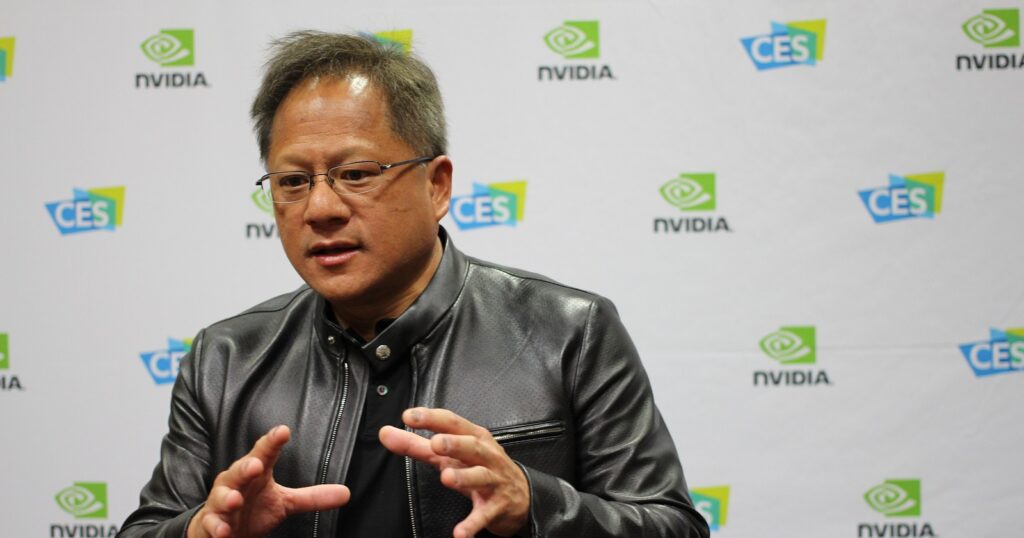
Jensen Huang has spent three years as the calm, leather-jacketed face of the AI boom, which is why Sunday's email to Nvidia staff landed so hard. "I was unfaithful to my wife," he wrote. "There is no excuse for what I did." The woman is Alice Huang (no family relation, as far as we know), a former executive at Megaspeed, a Singapore cloud company and one of Nvidia's biggest customers, and a memo circulating among US policymakers claims China's Ministry of State Security recruited her to get close to him. Nvidia's board has opened an independent investigation with outside counsel, says it has "no reason to believe" national security or company secrets were compromised, and is keeping Huang in the job while it looks.
The affair is admitted. Whether it was also espionage is now under investigation, and China’s embassy in Washington is having none of it.
What is actually alleged
The New York Times first reported on October 29 that Alice Huang had worked to build close ties with Huang to learn about Nvidia's technology. The smuggling part of the story belongs to her employer, not to him. Megaspeed has been accused of helping restricted Chinese buyers get Nvidia AI hardware, about $2 billion of it, including H100-class accelerators China is not supposed to have. Singapore has said Megaspeed is under investigation for possible breaches of local law, though it denies looking into any intelligence link. Nvidia says earlier diversion claims were checked and found nothing, and called Huang's contact with Megaspeed's executives "not unusual" for a large customer.
Huang himself is not accused of moving a single chip. The trouble is the picture it paints: the man who has lobbied hardest in Washington to sell more AI chips to China, close to an executive of a company accused of getting those chips there anyway.
Washington did not wait for the board to finish its coffee. Less than a week after the Times story, three House Republican committee chairs, John Moolenaar, Brian Mast and Rick Crawford, wrote to Huang asking him to brief lawmakers behind closed doors on November 18, and Senator Elizabeth Warren says he and the board “owe Congress answers”. That briefing lands the day after Nvidia reports its quarterly earnings, which is either terrible scheduling or excellent theatre.
Why AI stocks care about one man's private life
Nvidia went into the weekend at $186.64, worth about $4.5 trillion and already about 22% below its October record. Since the Times story on October 29 it has lost about 13%, including a 4% drop the next day. Most of the slide, though, has nothing to do with Huang: chip stocks were hammered last week, with Nvidia losing more than 9% on Thursday alone, as AI names sold off after the midterm results.
The scandal adds a different kind of risk. Huang is not a hired caretaker; he founded the company, he is its chief salesman to Microsoft, Meta and the rest, and he has been its envoy to the White House on export rules. A board investigation into a founder like that is key-person risk in its purest form, and because Nvidia is one of the heaviest weights in the S&P 500 and the Nasdaq, any wobble drags the whole AI trade with it: memory makers, server builders and every chip designer selling picks and shovels into the same data centers.
An affair, even a spectacularly badly chosen one, does not change what hyperscalers are buying. Earnings on November 17 will move the stock more than Sunday's email. The scenario that really hurts is the one where the probe or Congress finds that something did leak, because then the question is no longer Huang's judgement but Nvidia's access to the Chinese market and its standing in Washington.
Which leaves a question we cannot shake: did someone know before Friday’s close? The spy suspicion itself had been public since October 29, and the House letter went out on Wednesday, so the market already had most of the story. What it did not have was the confession and the board investigation, and those do not appear out of nowhere on a Sunday morning. Directors have to meet, outside lawyers have to be hired, and a CEO’s apology to his whole company gets drafted and read by more than one person, so a small circle knew days before investors did.
Friday does not look like a rush for the exit: Nvidia closed up almost 3%. Nothing we have seen says anyone traded on what was coming; whether anyone did, in shares or options, is exactly what the SEC checks before a market-moving announcement. The cleanest test is the open on Monday, November 9: a sharp drop means Sunday’s news really was news to the market.
What it means for gamers
Whatever the board finds, it will not change what a graphics card costs today. US graphics card prices are up about 24% over the last 90 days on Market Watch, and memory about 7%, and that is AI demand eating memory supply and fab capacity, not Huang’s private life.
Where it could help a little: enforcement. Chinese buyers have treated flagship GeForce cards as cheap AI hardware for years; that is why the RTX 4090 was caught by US export rules in 2023 and why China gets a cut-down RTX 5090D. If Washington cracks down on grey-market routes through Singapore and Malaysia, some of that pull on top-end cards goes away. The RTX 5090 is up close to 60% in 90 days on Market Watch, and a crackdown will not undo that, but it removes one buyer competing with you.
Where it could hurt: rules drawn with a wider brush. If Congress decides Nvidia cannot be trusted on China, broader export rules are the easiest lever to pull, and the 2023 rules already showed that a performance line written for data center parts can catch gaming cards too. A distracted CEO spending November in briefing rooms is the smaller worry; GeForce roadmaps are set years ahead and do not wait for board committees.
Where this could go from here
Four ways the next few months could go, from the most likely to the least.
It blows over
The probe clears Huang, the briefing is loud and goes nowhere, and earnings land well. AI development carries on at full speed: the data center build-out continues, Nvidia ramps its next generation, and the labs keep training bigger models.
For gamers this is, ironically, the worst outcome. Memory stays tight because the HBM stacked on every AI accelerator eats DRAM wafers that would otherwise become DDR5 and GDDR7, so graphics card and RAM prices stay high, probably well into 2027.
Washington tightens the screws on China
Huang loses his seat at the policy table, export rules get stricter, and enforcement finally goes after the Singapore and Malaysia routes. AI development splits further into two camps. Chinese labs lean harder on Huawei’s Ascend chips and on squeezing more out of less compute, which is exactly how DeepSeek caught everyone off guard in early 2025, while the rest of the world gets a little more Nvidia supply.
For gamers it is mixed. Less grey-market demand helps at the top end, where the RTX 5090 has been fighting AI buyers for every card. But if the new rules sweep in consumer cards, expect more China-only variants and messier launches everywhere else.
The AI trade cracks
Not because of Huang, but because earnings disappoint or the hyperscalers trim their spending, and the scandal becomes the excuse everyone was waiting for. AI development does not stop, it changes shape: fewer giant clusters announced, more work on efficiency, smaller models and cheaper inference.
For gamers this is the best case. Memory makers shift capacity back to consumer DRAM, Nvidia and AMD suddenly find gamers interesting again, and prices drift back toward MSRP. Not overnight, though: contracts and shop inventory take months to work through, so the relief would show up in 2027 rather than under this year’s Christmas tree.
Huang goes
The least likely outcome, and realistically one that needs the investigation to find a real leak. Nvidia would lose the person who has held CUDA, the hardware roadmap and the sales pitch together for three decades. Over a few years that opens the door for AMD, Google’s TPUs and Amazon’s Trainium, and for an AI industry less locked into one vendor’s software, which would be healthy for AI development even if it is painful for Nvidia shareholders.
What it means for GeForce is anyone’s guess. Gaming is already a small slice of Nvidia’s revenue next to the data center. A new CEO answering to Wall Street could treat it as even more of a side business, or lean on it as the steady earner that does not depend on hyperscaler budgets.
So watch two dates. November 17 tells you whether the AI trade holds, and with it, whether memory and graphics card prices have any reason to come down. November 18 tells you whether China rules get tighter. For your next upgrade, the first date matters far more than the second.
One last thing for the record: Huang is one of the most common surnames in Taiwan and China, so the shared name is almost certainly a coincidence. It may be the only part of this story nobody is investigating.
Cover photo: Maurizio Pesce, CES 2017, CC BY 2.0, cropped.
