
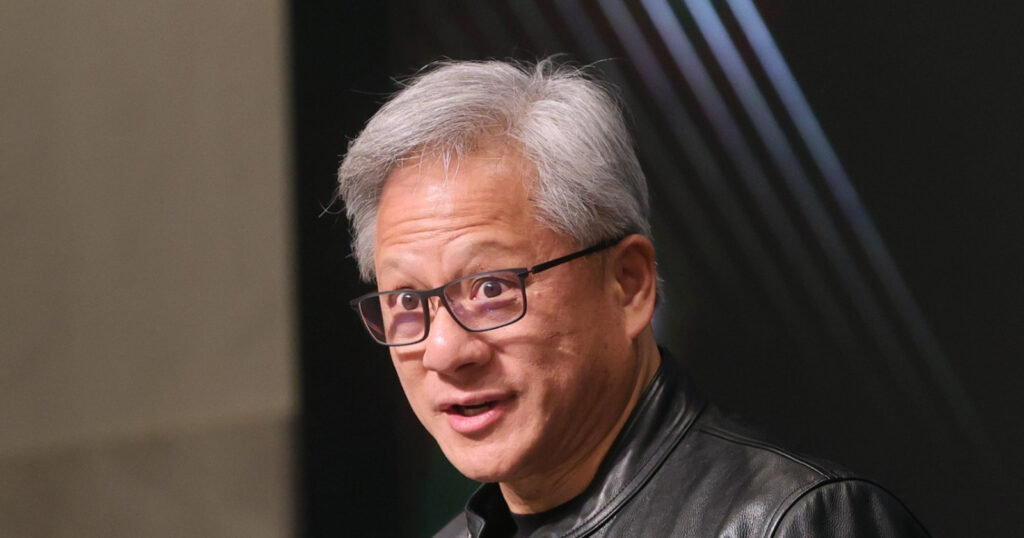
On Monday, this site asked whether Jensen Huang’s spy scandal would make your next graphics card cheaper. Buried toward the end was a list of four ways the next few months could go, from most likely to least. The last one was titled “Huang goes.” We called it the least likely outcome, “and realistically one that needs the investigation to find a real leak.”
Three days later, he is gone. And Nvidia has not said the investigation found a leak.
Nvidia’s board announced on Thursday that Huang has resigned as president, chief executive and a member of the board, effective immediately. In an 8-K filed Thursday, the company said the board accepted that resignation on Wednesday, November 11. Colette Kress, Nvidia’s chief financial officer since 2013, is interim CEO and keeps the finance job while the board searches for a permanent successor, from inside the company and outside it. Harvey C. Jones, a director since 1993 and a former chief executive of Synopsys, becomes the first chair Nvidia’s board has ever had.
The statement thanks Huang for 33 years and calls his contributions “profound.” It does not mention the affair he admitted to his staff on Sunday, the alleged Chinese intelligence recruitment around it, the letters from Congress, or the second relationship The New York Times reported on Wednesday. Huang is not quoted at all. Jones says the board expects “the company’s operations, customer commitments and product roadmap to continue without interruption.” Kress says she is “committed to building on the extraordinary foundation Jensen created.”
That is the official version. It reads like a scheduled succession. It is not one.
What just happened, and what did not
The facts of the scandal have not moved much. Huang admitted, in a Sunday email to staff, that he was unfaithful to his wife. The woman at the center of that admission is Alice Huang, a former executive at the Singapore cloud firm Megaspeed, and a memo circulating in Washington claims China’s Ministry of State Security recruited her to get close to him. The two are not related. Nvidia’s board hired the law firm Wachtell, Lipton, Rosen & Katz for an independent investigation, said it had “no reason to believe” national security or company secrets were compromised, and, at the start of the week, was keeping Huang in the job while it looked. The affair is admitted. The espionage question is still an allegation, and China’s embassy in Washington has rejected it.
What changed is the pressure. Late Wednesday, The New York Times reported a second extramarital relationship, this time with a vice president at the company. The board accepted his resignation the same day. You can read that as a conduct decision, a political one, a national-security one, or all three. You cannot read it as a finished investigation. The company has not told us the probe found a leak, and it has not told us the probe is done.
Shares fell more than 10 percent when US markets opened on Thursday, and some reports put the opening drop above 13 percent. That is a violent morning, and it is also a moving number, so do not treat any one print as the last word. The more useful point is that investors are now pricing a key-person risk that was still theoretical a few days ago and is concrete today.
What it means for Nvidia
Huang co-founded the company in 1993 and never really built it to run without him. TechCrunch reports that he had around 60 people reporting directly to him, an unusually flat structure for a firm this size, and Quartz, citing The Wall Street Journal, says he has dismissed the value of mapping out a successor. He is the largest individual shareholder, at about 3.5 percent, but he does not have the special voting rights that keep many Silicon Valley founders in the chair no matter what the board thinks. The board could do this. It just did.
Putting the chief financial officer in as interim is a “steady the ship” move, and that is roughly how analyst Dan Ives described it to CNBC, including a guess that the interim stretch lasts about a year and that the permanent job may go to an outsider. Kress has been inside Nvidia’s numbers and customer contracts for 13 years, which includes the entire AI boom. She will be fine on an earnings call. Tuesday’s fiscal third-quarter results are still scheduled for about 1:20 p.m. Pacific, with the call at 2. That is five days from now, and it will be the first time the company talks to Wall Street without the man who usually does the talking.
What she is not, at least not yet, is the leather-jacketed salesman who sat with Microsoft and Meta, or the envoy who lobbied the White House on export rules. Nvidia’s data-center business was never just a product catalog. It was a web of investments, cloud commitments and credit guarantees that helped customers buy the very chips Nvidia sells. TechCrunch put some of that book at $99 billion of investments and another $25 billion of commitments at the end of the last quarter, plus $36 billion in cloud-service commitments, and deals involving OpenAI, Anthropic, CoreWeave and others. Those arrangements do not vanish because the founder resigned. They do get a little harder to explain, and a little easier for customers to revisit, when the personal relationship at the center of them is gone.
The first-ever board chair is easy to skip past, and you should not. For three decades the company was organized around one person. A chair, an interim CEO who also runs finance, and an open search for internal and external candidates is a different company, even if every product roadmap stays on the slide deck. The honest risk is not that the next data-center generation or the next GeForce gets cancelled next week. It is that a firm this concentrated in one founder takes years to learn how to make the same kind of bets without him, and that rivals such as AMD, Google’s TPUs and Amazon’s Trainium get a window they did not have when Huang was the whole pitch.
A new CEO, whenever one arrives, will be judged on whether the software lock-in around CUDA holds, whether the big buyers stay, and whether Washington still takes Nvidia’s calls. The hardware teams can keep shipping. The relationship layer is what just walked out.
What it means for the AI industry
Demand for accelerators does not resign. The labs still need the chips, and the build-out does not pause for a board meeting. That is the calming story, and it is mostly true in the short run.
The less calming story is that the AI trade has spent two years treating Nvidia, and Huang personally, as a single point of failure it would rather not look at. The company is a huge weight in the S&P 500 and the Nasdaq. When it stumbles, memory makers, server builders, specialist cloud firms and the labs all get marked down with it. TechCrunch reported CoreWeave, Nebius and IREN all selling off Thursday morning. Some of that is sympathy selling. Some of it is a real question: if Nvidia gets more cautious with the money it has been circulating through the same ecosystem, the financing gets tighter even if the chips keep coming.
Washington is the other room. Three House committee chairs had already asked Huang to brief them behind closed doors on November 18, the day after earnings, and Senator Elizabeth Warren said he and the board “owe Congress answers.” Someone will still have to walk into that room. It will not be the CEO who spent years arguing for more chip sales to China, and who is now the subject of the questions. If the mood in Congress is to tighten export rules and go after grey-market routes through Singapore and Malaysia, Huang’s absence makes that easier, not harder. Chinese labs were already being pushed toward Huawei and toward doing more with less, which is the DeepSeek story from early 2025. A harsher split is now a little more likely than it was a few days ago.
Over a longer stretch, a Nvidia that is slightly less dominant would be healthy for AI development, even if it is painful for Nvidia shareholders. That is no longer a thought experiment.
What it means for gamers
The question worth asking is what a card costs in three months, six months, or a year, and Huang leaving does not make that simple. US graphics card prices were already up about 24 percent over 90 days on Market Watch, and memory about 7 percent, because AI demand is eating wafers. That pressure does not leave with the founder. Kress is a finance chief whose job, over the next few quarters, is to protect the data-center cash engine. That points to stable GeForce margins, not a campaign to win gamers back on price.
A new CEO answering to Wall Street could treat gaming as even more of a side business, or lean on it as the steady business that does not depend on hyperscaler budgets. That fork is now real. While Kress is interim, the path leans toward the first option: keep the roadmap, keep the margin, do not get distracted. GeForce launches are set years ahead, and they do not wait for board committees. Over a year, a permanent CEO who wants a business that is not one earnings miss away from an AI-trade panic might actually rediscover gamers. I would not bet a preorder on that, but I would not rule it out either.
The export-rule risk is, if anything, a little sharper over that same stretch. If Congress decides Nvidia cannot be trusted on China, broader rules are the easy lever, and the 2023 controls already showed that a line drawn for data-center parts can catch gaming cards too. A crackdown on grey-market AI buyers of flagship GeForce cards could, over the coming months, take one competitor out of the RTX 5090 queue. A wider brush could make launches over the next year messier.
The two dates are still the two dates
November 17 still tells you whether the AI trade holds, and with it, whether memory and graphics card prices have any reason to come down. The difference is who is on the call. November 18 still tells you whether China rules get tighter. The difference is who is in the briefing.
One thing has already been decided. Nvidia is, for the first time in 33 years, a company whose founder is not the chief executive, not on the board, and not the person who will have to answer for what comes next. The product roadmap can continue without interruption, as the new chair says. The era cannot.
Huang’s timeline in NVIDIA (1993 – 2026)
Huang co-founded Nvidia on April 5, 1993, with Chris Malachowsky and Curtis Priem, with a vision to bring 3D graphics to games and multimedia. He was president, chief executive and a director from the first day, and he still held all three jobs when the board accepted his resignation on Wednesday, November 11, 2026, effective immediately. Thirty-three years and a little more than seven months, start to finish.
In between, Nvidia popularized the GPU, opened CUDA, and became the company the AI industry is built around. He was in the chair for all of it. As of Wednesday, he is not.
Cover photo: Office of the President of Taiwan, November 2023, CC BY 2.0, cropped.
