

NVIDIA’s GeForce feed this week centered on two game launches: The Witcher 3: Wild Hunt – Remastered on September 29 and Gears of War: E-Day on October 1. Gears is where the new technology is.
Gears of War: E-Day gets RTX Mega Geometry
Unreal Engine 5’s Nanite scales geometry detail automatically, but NVIDIA says that once ray tracing is on, Nanite objects switch to a single static low-detail mesh, because building acceleration structures for them is too expensive with existing DXR 1.2 and Vulkan APIs. The result is shadows and reflections that do not match the geometry on screen. NVIDIA says six years of work produced RTX Mega Geometry as the fix, that it debuts in this game, and that Microsoft’s DirectX Raytracing 2.0 standard will adopt it.
A GeForce RTX GPU with at least 12GB of VRAM is required to enable the feature. By NVIDIA’s own spec page, the RTX 5060 has 8 GB and the RTX 5060 Ti comes in 16 GB and 8 GB versions, so the RTX 5060 and the 8 GB Ti sit below the line even though they carry the ray tracing hardware. The cards NVIDIA names in its results stop at the RTX 5070.
Availability is staggered. The game is playable from October 1 through Premium Edition Early Access and from October 6 for everyone else. On GeForce NOW, Ultimate members can stream it at launch, “soon with DLSS 4.5, ray tracing and RTX Mega Geometry”, and NVIDIA’s October games list puts the cloud release at October 6. Neither says the cloud version has those features on day one.
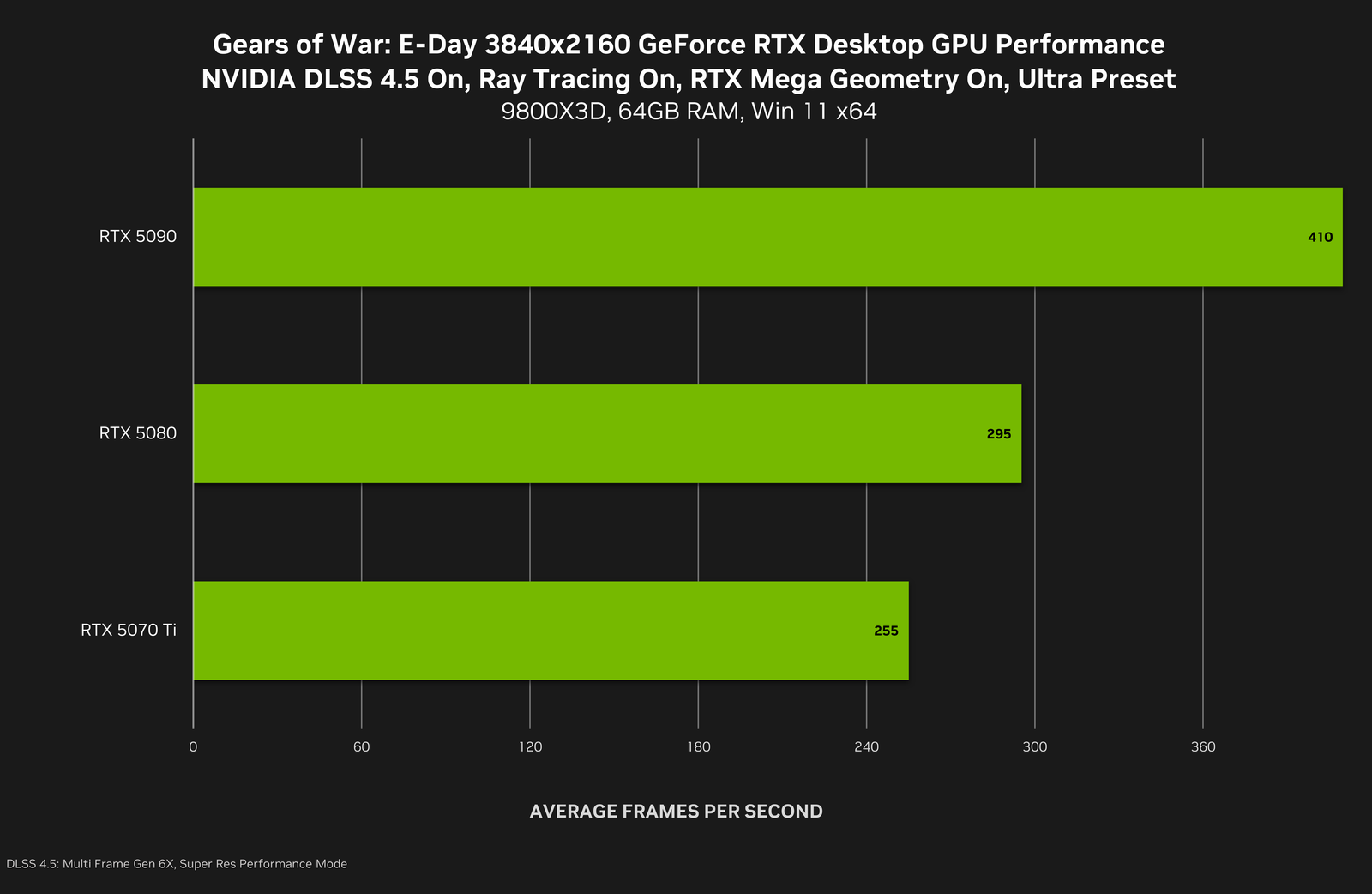
On performance, NVIDIA says a fixed 6X Multi Frame Generation multiplier with Ultra preset ray tracing and RTX Mega Geometry runs on average 7.5X faster than native rendering at 4K, with up to 410 FPS on the RTX 5090, over 290 on the RTX 5080 and 250 on the RTX 5070 Ti. It also says Reflex cut PC latency by up to 50% in its campaign benchmark, and gives no absolute latency for the frame-generated runs.
The Witcher 3 Remastered: free path tracing, with path-traced hair on RTX 50 cards
CD Projekt Red’s free update renames the game and, NVIDIA says, moves it to an exclusively DirectX 12 renderer, replacing the hybrid DirectX 11/12 one from the 2022 Next-Gen update. Path tracing is the headline feature, and Shader Execution Reorder improves its performance on RTX 40 and 50 Series cards.
The narrower feature is hair. Path-traced hair for Geralt and every HairWorks-enhanced character uses Linear-Swept Spheres and runs on RTX 50 Series GPUs, whose fourth-generation Ray Tracing Cores added support for those primitives. Spheres and tubes replace triangles, which NVIDIA says cuts the geometry and memory that building a BVH for individual strands normally costs. Turning on path tracing with the Ultra+ preset switches on Ray Reconstruction automatically.
At 4K, 6X Multi Frame Generation and Ray Reconstruction give up to 385 FPS on the RTX 5090 and 245 on the RTX 5080, NVIDIA says. The same two cards reach up to 420 and 320 at 2560×1440 and up to 430 and 410 at 1920×1080, with no multiplier restated for those runs. Every upgrade will also carry over to the Songs of the Past expansion, due in 2027, and the base game is already streaming on GeForce NOW for Performance and Ultimate members, according to the same games list.
The rest of the week’s DLSS list: Enlisted, SILENT HILL: Townfall, AION 2 and ACE COMBAT 8
The Witcher post doubles as the week’s DLSS roundup. Enlisted’s Off-Road Patrol update shipped DLSS 4.5 Ray Reconstruction, 6X Multi Frame Generation and path-traced global illumination that bounces light up to three times. SILENT HILL: Townfall launched with DLSS Super Resolution, and players can upgrade it to the 4.5 model through the NVIDIA app. AION 2 opened global access on September 30 for Founder’s Pack buyers with free-to-play to follow on October 5, and ACE COMBAT 8: WINGS OF THEVE began Advance Access with DLSS 4.5 Super Resolution and DLAA. Neither lead post announces a new driver, and NVIDIA says players should install the most recent Game Ready driver.
Our view: if the 410 FPS comes from the same runs as the 7.5X figure, native 4K on the RTX 5090 would be near 55 FPS, with the 6X multiplier supplying most of the gain and upscaling the remainder. That is our division of NVIDIA’s numbers, not a measurement.