

Remedy's CONTROL Resonant launched on September 24 with path tracing on GeForce RTX, and NVIDIA spent most of its week on it: a launch post with performance charts, a Game Ready driver, and a same-day GeForce NOW release. The charts are the part worth reading closely.
What the 328 FPS figure is made of
Selecting the game's "Ray Tracing Preset: Ultra" turns on full path tracing, and on GeForce RTX it switches on DLSS 4.5 Ray Reconstruction automatically. On top of that sits Dynamic Multi Frame Generation, which either runs a fixed multiplier up to 6X or adjusts the multiplier on the fly to hold a frame rate the player picks.
According to NVIDIA, its 4K chart puts the RTX 5090 at 328 average FPS and the RTX 5080 at 220, measured by NVIDIA on a Ryzen 7 9800X3D system with 64GB of RAM. The footnote carries the conditions: Multi Frame Generation at 6X, Ray Reconstruction on, and Super Resolution in Performance mode.
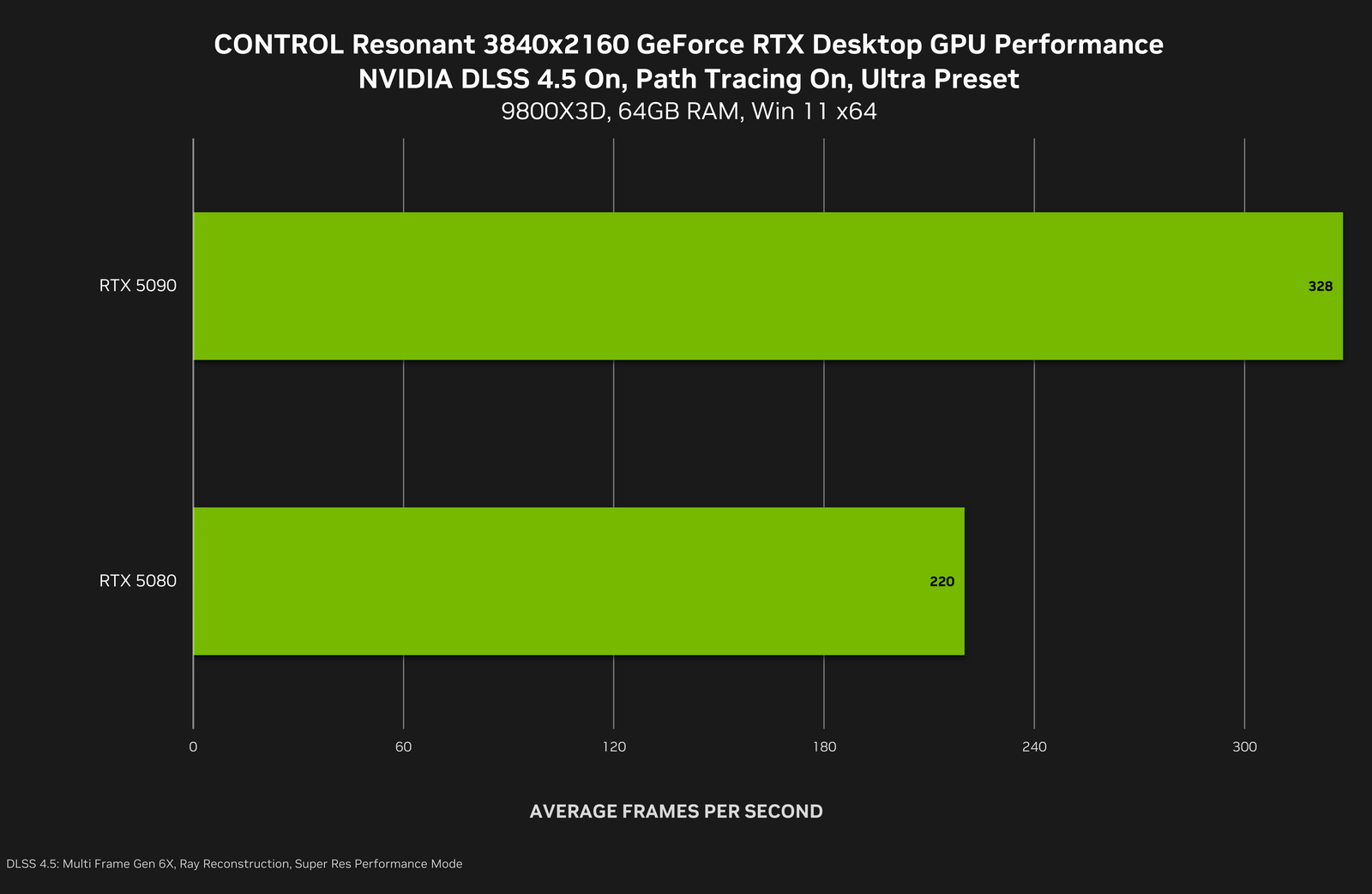
Those two settings do most of the work. Performance mode renders internally at half the output resolution on each axis, so the game is drawing 1920×1080 frames and upscaling them to 4K. At 6X, one frame in six is rendered and five are generated. Divide it out and the RTX 5090 renders roughly 55 frames a second and the RTX 5080 roughly 37. Input response follows the rendered frames, not the displayed ones, and NVIDIA published no latency figure to show how that feels.
None of that makes the result bad. Around 55 rendered frames a second of full path tracing at a 1080p internal resolution is a strong showing for the RTX 5090, and it is the configuration NVIDIA designed the feature for. It is simply not what "328 FPS at 4K" suggests on its own. The post's lower-resolution claims run all the way down to 215 FPS for an RTX 5060 Ti at 1080p; its text does not restate the multiplier for those runs, so the same division should be treated as a likely reading rather than a given. All of these are NVIDIA's own numbers until someone tests the game independently.
GeForce NOW Ultimate members got the game at launch, streaming at what NVIDIA calls RTX 5080-class performance. The two NVIDIA posts disagree on the details: the GeForce News article says the full DLSS 4.5 suite reaches GeForce NOW, while the GeForce NOW blog lists DLSS 4 for the cloud version.
Driver 617.14 fixes three R615 regressions
Game Ready 617.14 WHQL arrived on September 22 on the R615 branch, following 616.92. Its release notes list three fixes that matter more than the game profiles:
- Judgment, Lost Judgment and Virtua Fighter 5 R.E.V.O. could fail to launch after driver 616.56.
- A Samsung Odyssey G95NC connected over HDMI could show no picture after moving to R615.
- Some monitors on DisplayPort could fail to wake from sleep after moving to R615.
Anyone who held back on R615 because of a blank or sleeping display has a reason to try again. One open issue carries over: Assassin's Creed Shadows may still crash to desktop after long sessions, a problem the notes trace back to 616.56. None of this appears in NVIDIA's news post, only in the release notes PDF.
The profiles themselves are mostly for games that were not out yet when the week closed. AION 2 launches globally on September 30 for Founder's Pack buyers and goes free-to-play on October 5, with DLSS 4.5 Super Resolution and Multi Frame Generation. Gears of War: E-Day opens Early Access on October 1 ahead of a full release on October 6. It is built on Unreal Engine 5 with Lumen and MegaLights, and NVIDIA says its RTX Mega Geometry lets the game ray trace Nanite geometry accurately for the first time. The Witcher 3: Wild Hunt Remastered is a free upgrade due September 29, adding path tracing, path-traced hair built on line swept spheres, DLSS 4.5 Ray Reconstruction, and up to 6X Dynamic Multi Frame Generation on RTX 50-series cards. All three are promised features until the games ship.
GeForce NOW is coming to Googlebooks
NVIDIA also said GeForce NOW support is coming to Googlebooks, Google's new ChromeOS and Android laptop category, which starts rolling out this fall. There is no date for the app itself; NVIDIA says availability details will follow later this year.