
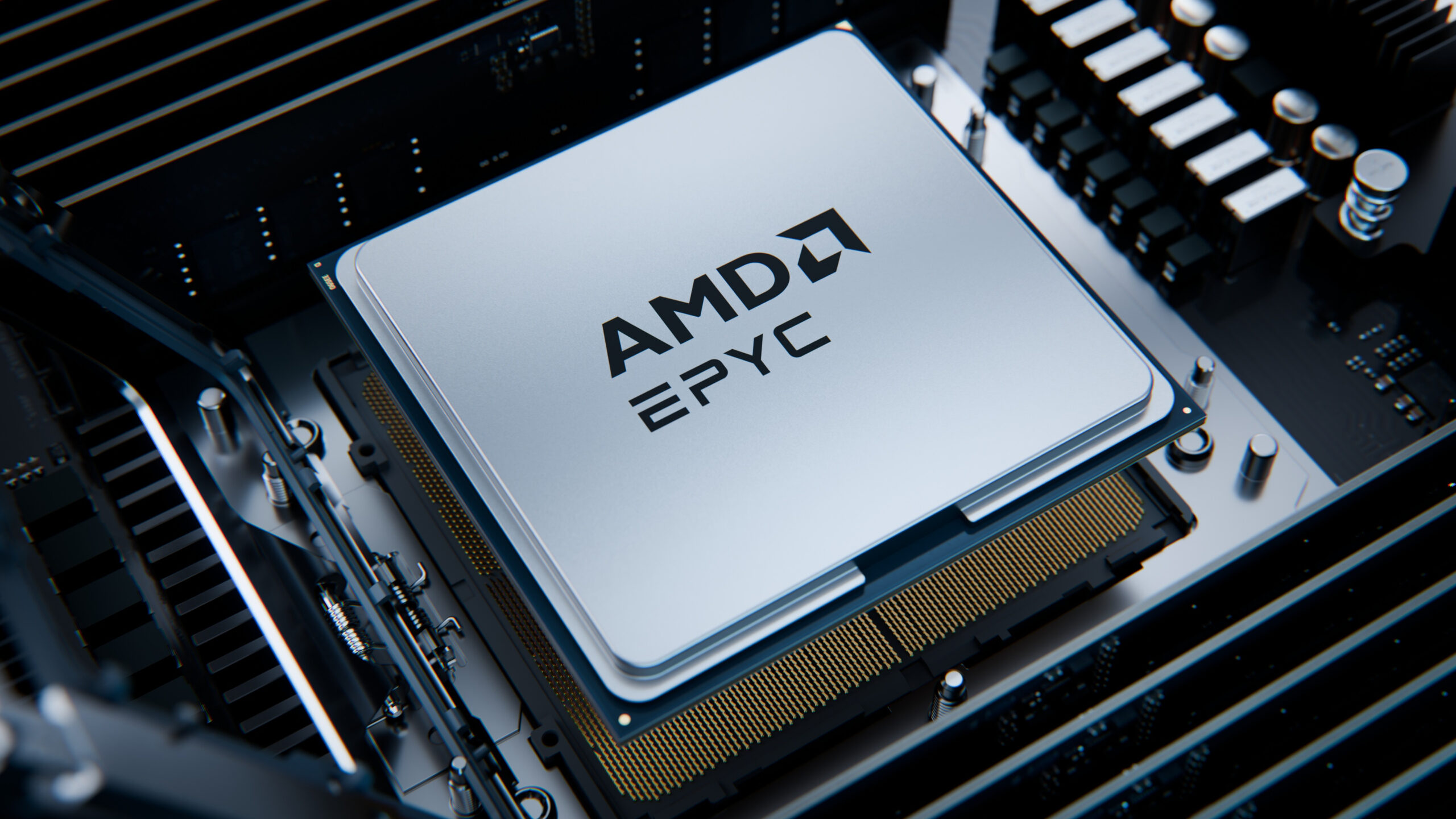
AMD announced on November 10 that its 6th Gen EPYC SP7 processors, built on the Zen 6 architecture, are generally available, with systems already shipping from server OEMs and ODMs. In the press release, AMD calls the EPYC 9996, which has 256 cores, the world’s best general-purpose processor and puts it well ahead of Nvidia’s Vera and Intel’s Xeon 6980P. Azure and Oracle Cloud instances are listed as coming soon, and Meta is named as a lead customer validating the platform.
AMD’s table puts the 9996 at 5,470 against 2,510 for the Xeon 6980P
The comparison sits in the release’s footnotes, as two-socket SPECrate 2017 integer base scores that AMD says are published results as of November 5. A pair of EPYC 9996 (512 cores in total, 600 W Default CPU Power, $14,904 per CPU in AMD’s table) reaches 5,470. The 5th Gen EPYC 9965 (384 cores, 500 W TDP, $11,988) reaches 3,260, so the new chip buys its higher score with more cores, more rated power and a higher price. The Xeon 6990E+ lands at 3,050 and the Xeon 6980P at 2,510, which is where AMD’s 2.2 times the performance and 2.0 times the performance per dollar over the 6980P come from.
The power column has a new name. AMD now quotes Default CPU Power, which it defines as the power of the compute and I/O dies together for the stated performance target, and says it can be used alongside TDP. The performance-per-watt and per-dollar columns divide a two-socket score by the power or price of one CPU, so the 9.117 points per watt for the 9996 is not a system efficiency figure. Every row uses the same method, which keeps the ratios comparable.
The 3.7 times lead over Vera compares a published AMD score with an AMD estimate
Nvidia’s Vera and Arm’s AGI have no published SPEC scores in the table. AMD’s footnote labels both as internal estimates from engineering projections, and the Vera figure of 1,459 for two sockets (176 cores, 450 W) is based on Phoronix testing. Dividing 5,470 by 1,459 gives the 3.7 times in the release. AMD also notes that no Vera price has been published, so there is no performance-per-dollar figure for it. Nvidia has made its own Vera-versus-x86 claim, which we covered.
The “best” label is narrower than it sounds. AMD’s footnote says it reflects AMD’s own assessment, as of July 23, of the overall mix of projected performance, thread density, efficiency, memory, I/O and security among general-purpose server CPUs, and does not imply a lead in every workload or metric.
The agent and host-node figures rest on a projection and a power cap
For GPU host nodes, AMD says its high-frequency parts deliver up to 1.8 times the LLM output throughput of the previous generation, with clocks up to 5.3 GHz. The footnote shows that the measurement was made on PCIe Gen 5 systems with one Nvidia B200 running Qwen3-30B-A3B with weights offloaded to the CPU. Throughput there was limited by the PCIe link, so AMD projected the Zen 6 result from doubling the link bandwidth for PCIe Gen 6, which gives a ceiling of 1.8 to 1.9 times.
The agent-density claims use thread counts as a stand-in for agents under what AMD calls a theoretical workload. They give up to about 3.3 times the agents per CPU watt of Vera and about 2.5 times that of the Xeon 6980P. The 1.18 times as many agents per 35 kW rack is a different comparison: it is the same 9996 servers with a power limit set 15% lower, against the same servers at default power management. AMD bases the 1% performance cost of that limit on testing of a 128-core 5th Gen EPYC, not on Zen 6.
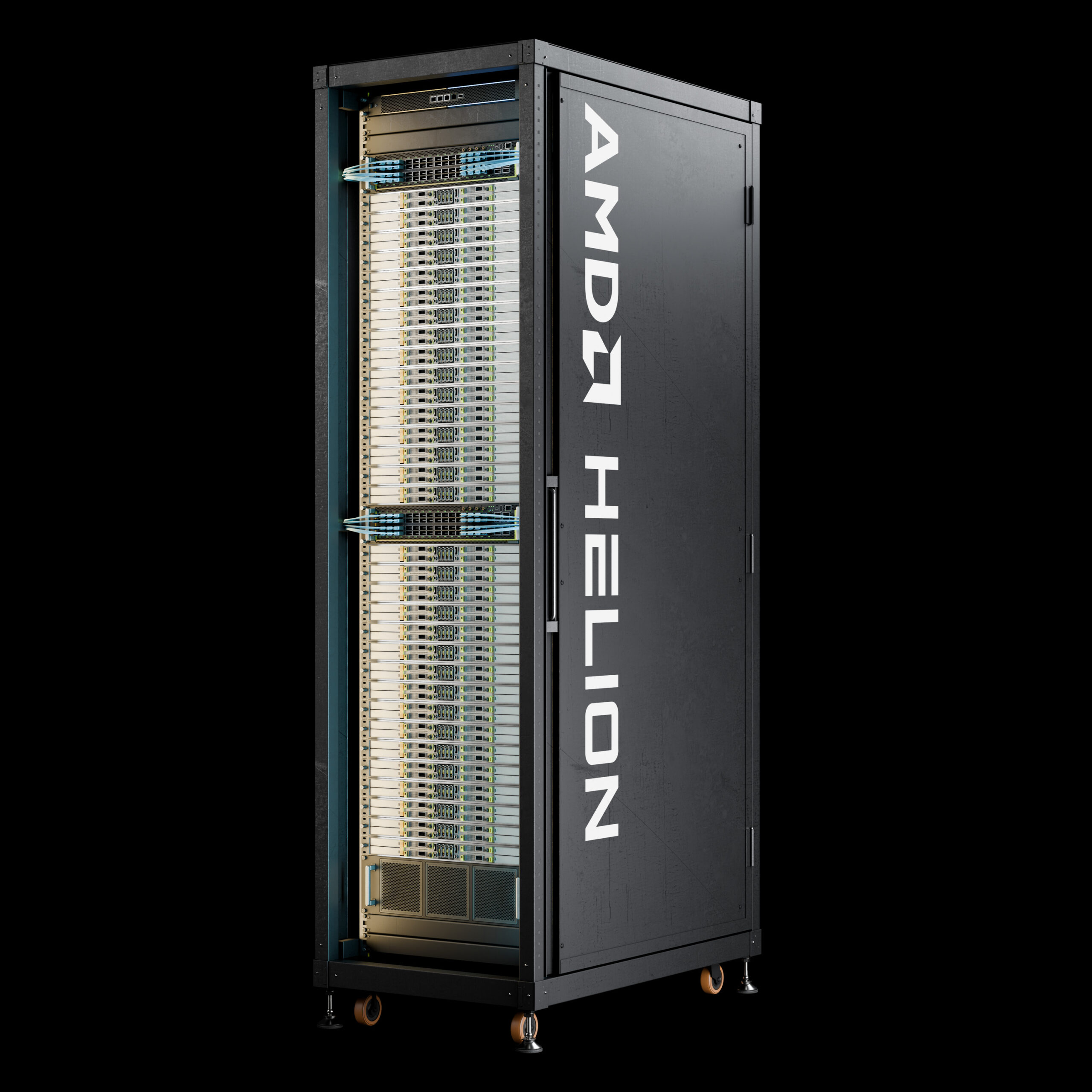
Alongside the chips AMD showed its Helion agentic AI racks in Liquid, Air and Air Inference versions, with some configurations reaching 73,728 threads in one rack. Azure HDv2 instances are in preview now, and OCI Compute E7 instances will use the new chips.