

NVIDIA announced Snapshot on November 10, an open-source checkpoint and restore system for GPU workloads on Kubernetes that belongs to its DSX AI Factory Platform. In its technical blog post, NVIDIA says Snapshot captures a fully initialized inference replica, CPU and GPU memory included, so a new pod can resume from that state without loading weights, compiling kernels or capturing CUDA graphs again.

Restores took 3.6 to 42.7 seconds on B200 GPUs, and the cold starts they replace took far longer
NVIDIA says it tested vLLM 0.31.0, SGLang 0.5.21 and TensorRT LLM 1.3.0 on NVIDIA B200 GPUs with VAST NFS storage, using models from Qwen3-0.6B to DeepSeek-V4-Pro-NVFP4, whose weights are 913 GB spread over eight GPUs. Restores took 3.6 to 42.7 seconds, or 8 to 36 times faster than a cold start. The largest mixture-of-experts models, with checkpoints of about 600 GB to 1 TB, came back in under 43 seconds against cold starts of 6 to 19 minutes.
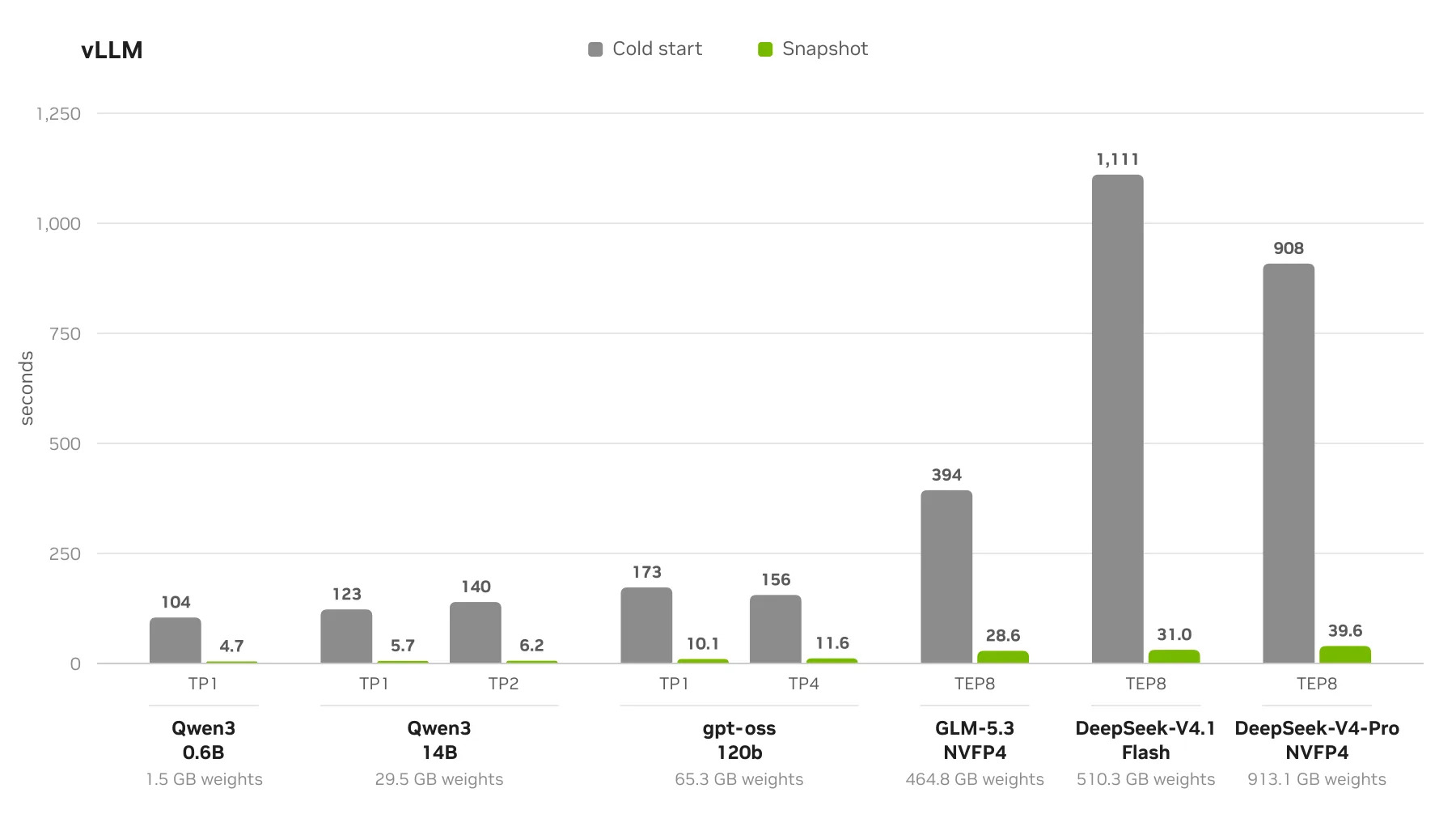
The multiple depends heavily on the cold start it is divided into. DeepSeek-V4.1-Flash on vLLM shows the largest gain, 35.87 times: its cold start took 1,110.65 seconds, of which 784.54 seconds went to compilation, autotuning and graph capture, and the restore took 30.96 seconds. The smallest gain, 8.10 times, is gpt-oss-120b on SGLang across four GPUs, at 240.17 seconds cold and 29.64 seconds restored. The multiple may therefore say as much about how long an engine takes to initialize as about the restore itself.
Moving data sets the floor for restores. In the eight-GPU configurations, restoring GPU state takes 18 to 29 seconds and restoring the CPU process state, which uses the standard Linux CRIU tool, takes 4.2 to 10.8 seconds.
Checkpoints can be many times the size of the weights, and the timings leave out the image pull
The table lists a checkpoint of 693.89 GB for gpt-oss-120b on SGLang across four GPUs, whose weights are 65.25 GB. The same model on vLLM across four GPUs has a 119.69 GB checkpoint. Creating a checkpoint took 15 seconds to 5.5 minutes, a one-time cost per configuration, and NVIDIA says checkpoint time plus restore time was shorter than a single cold start in every configuration it tested.
NVIDIA says a restore can start a new pod on any node with the same GPU model and driver as the checkpoint. The measurements leave out provisioning the machine and pulling the container image, so they cover the engine’s startup and not the whole time before a replica serves traffic.
NVIDIA also cites two design partners on their own workloads, both on NVIDIA HGX B300 systems. Crusoe cut readiness for GLM-5.3 from roughly 8 minutes to 31 seconds, and Saturn Cloud cut vLLM startup from 2 to 8.5 minutes to 6 to 34 seconds.
A workload needs a small handshake to pause before a checkpoint and resume after a restore, and the repository has ready-made examples for vLLM, SGLang and TensorRT LLM.