

Kioxia has introduced the LD4 Series, its first E1.L SSD, built on eighth-generation BiCS FLASH QLC memory. The company describes it as a drive for high-density 1U servers and read-intensive storage. It is sampling to select customers now and goes on show at the OCP Global Summit in San Jose, October 12 to 15.
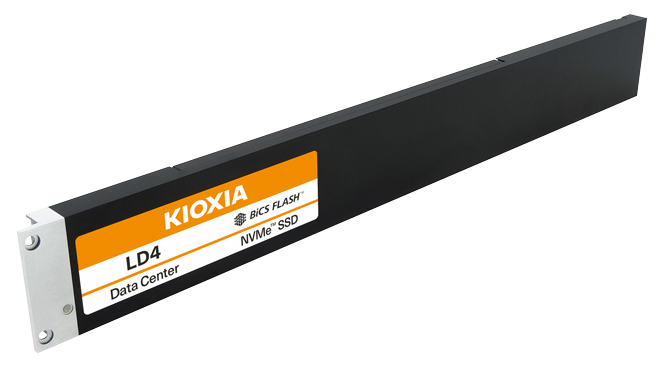
The sampling drives hold 15.36 TB and 30.72 TB, while 122.88 TB is a validated architecture
The release lists two capacities, 15.36 TB and 30.72 TB, and adds a “validated architecture enabling capacities up to 122.88 TB”. The largest number therefore appears to be a design limit rather than a capacity of any drive Kioxia has listed. Kioxia also notes that the samples are for functional checks and that their specifications may differ in mass production.
The drive follows NVMe 2.0e and the Open Compute Project’s Datacenter NVMe SSD specification v2.6, in a single-port design for hyperscale servers.
The LD4 link tops out at 16 GT/s per lane, half the lane speed of Kioxia’s CM9-R
Kioxia says the interface is “PCIe 5.0 (Gen 4 x4)”, and a footnote gives it as compliant with the PCIe 5.0 specification at up to 16 gigatransfers per second on four lanes. That looks like the Gen 4 per-lane rate, in line with the release’s own Gen 4 x4 label. Kioxia’s CM9-R page lists 128 GT/s for a PCIe Gen5 x4 link and sustained sequential reads of up to 14,800 MB/s. Divided across four lanes, that suggests 32 GT/s per lane, which may be twice the LD4’s figure.
The release gives no performance, endurance or power figures for the LD4. For a QLC drive aimed at read-intensive work, the lane speed may be a design choice rather than a shortfall, though Kioxia does not say so.