

Alibaba Calls the Zhenwu V900 Its Most Powerful Chip, With No FLOPS to Back It
Alibaba's chip design arm, T-Head, unveiled the Zhenwu V900 AI accelerator at the company's Apsara Conference in Hangzhou on September 22. Alibaba CEO Eddie Wu called it the most powerful AI chip the company has built, at three times the performance of last year's Zhenwu M890. That is a claim resting on Alibaba's own comparison rather than an independent measurement.
The V900 carries 216GB of on-package memory, more than the 141GB on Nvidia's H200. It also offers 1.2TB/s of inter-chip bandwidth over Alibaba's ICN Switch fabric, with native FP8 and FP4 support, Wccftech's coverage of the launch noted. Alibaba says a cluster built on the chip can scale to 500,000 cards, with more than 1,000 V900s already able to run as a single system, up from the M890's 128-chip ceiling. Commercial availability moved up to the first quarter of 2027, from the third quarter the company had targeted as recently as May.
What Alibaba did not publish is a FLOPS figure, a process node, a foundry, or a power rating. Those are the numbers that would let "most powerful" be checked rather than taken on faith. Wccftech's own estimate extrapolates from the M890's claimed 0.6 PFLOPS at FP16 and puts the V900 near 1.8 PFLOPS at the same precision, a figure Alibaba itself has not confirmed. For comparison, Huawei's Ascend 960PR, due the same quarter, is specced at 192GB of memory, 2.4TB/s of memory bandwidth, and a 2.2TB/s scale-up interconnect, numbers Huawei did publish.
Alibaba is pitching the V900 as one piece of a larger buildout. It wants more than 20 gigawatts of data center capacity by 2032, and says Qwen models are headed toward the 5-trillion-to-10-trillion-parameter range, up from Qwen3.8-Max's 2.4 trillion. Wu also acknowledged a constraint that sits oddly next to a chip Alibaba is calling the country's fastest: "global shortages in the AI supply chain are currently limiting the speed at which we can scale our compute infrastructure."
Nvidia Launches DSX Ready to Certify AI Factory Power and Cooling Gear
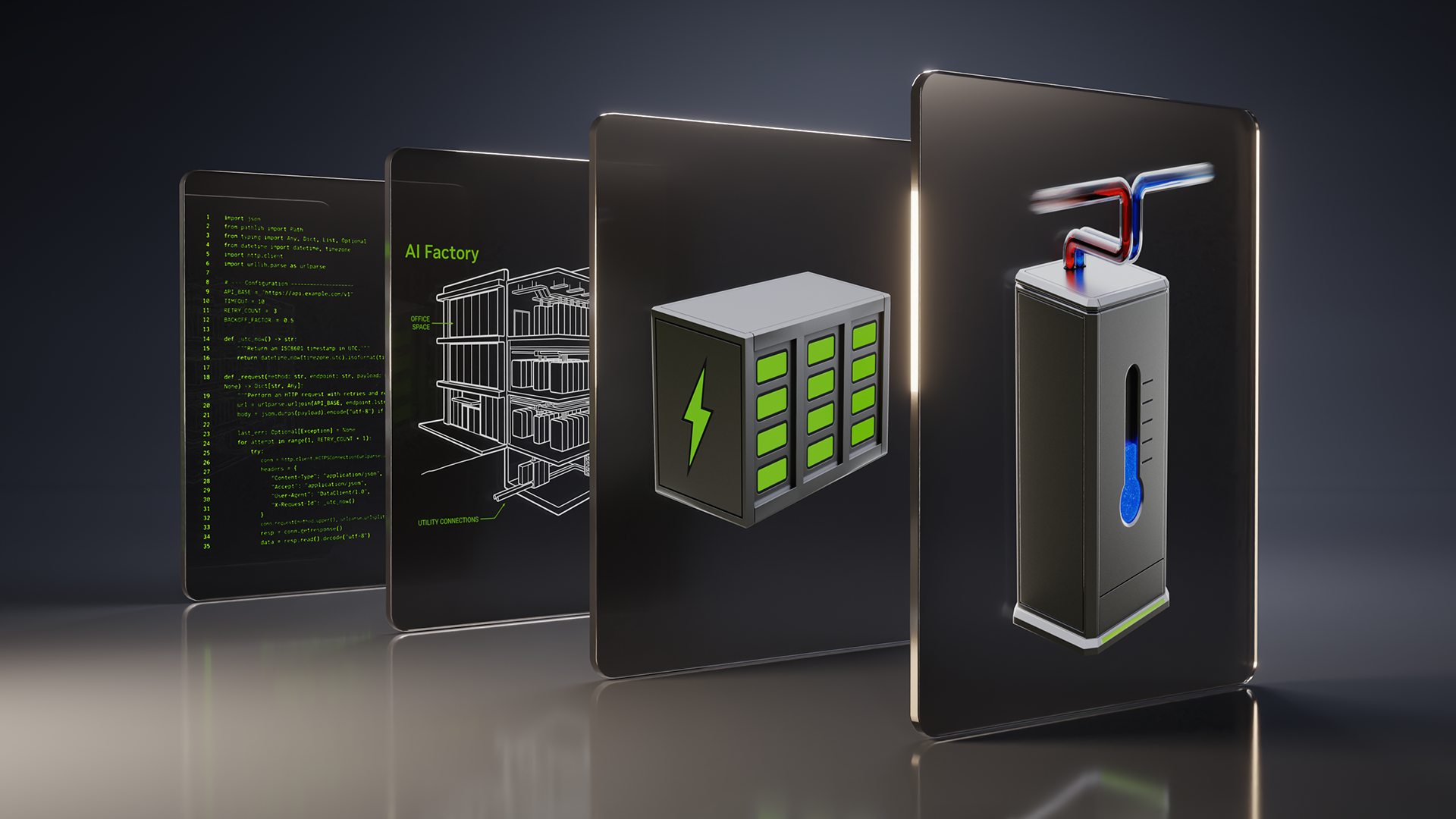
Nvidia announced DSX Ready on September 21, a qualification program that certifies third-party power and cooling hardware for its DSX AI factory racks. The program starts with two categories Nvidia itself does not make: battery energy storage systems (BESS) and liquid-cooling distribution units (CDUs).
The two qualification paths carry different levels of scrutiny. CDU vendors can self-certify against Nvidia's published function and performance specifications, subject to Nvidia's final sign-off. BESS vendors have to run Nvidia's required tests themselves and submit the data for Nvidia's review. Nvidia attributes that heavier process to the more complex electrical engineering involved. The launch partners are LG Electronics, LiquidStack, and Vertiv for cooling, and Hitachi Energy, LG Energy Solution, and Tesla for batteries. Nvidia says more hardware categories will follow.
None of this is silicon. DSX Ready extends Nvidia's brand and approval process into the parts of an AI factory it doesn't build: the power and cooling infrastructure that increasingly decides how much compute a site can actually run. A "DSX Ready" badge on a CDU or battery system tells a builder that Nvidia checked the part against its own rack specifications, not that the part is interchangeable with an uncertified one. Nvidia is explicit that qualification doesn't replace site-level engineering.