

AMD published a new white paper this week arguing that its upcoming 6th Gen EPYC "Venice" server CPU beats Nvidia's still-unreleased Vera CPU by a wider margin than AMD itself claimed three months ago, and the gap grew because AMD changed how it measures the gap.
What AMD is claiming
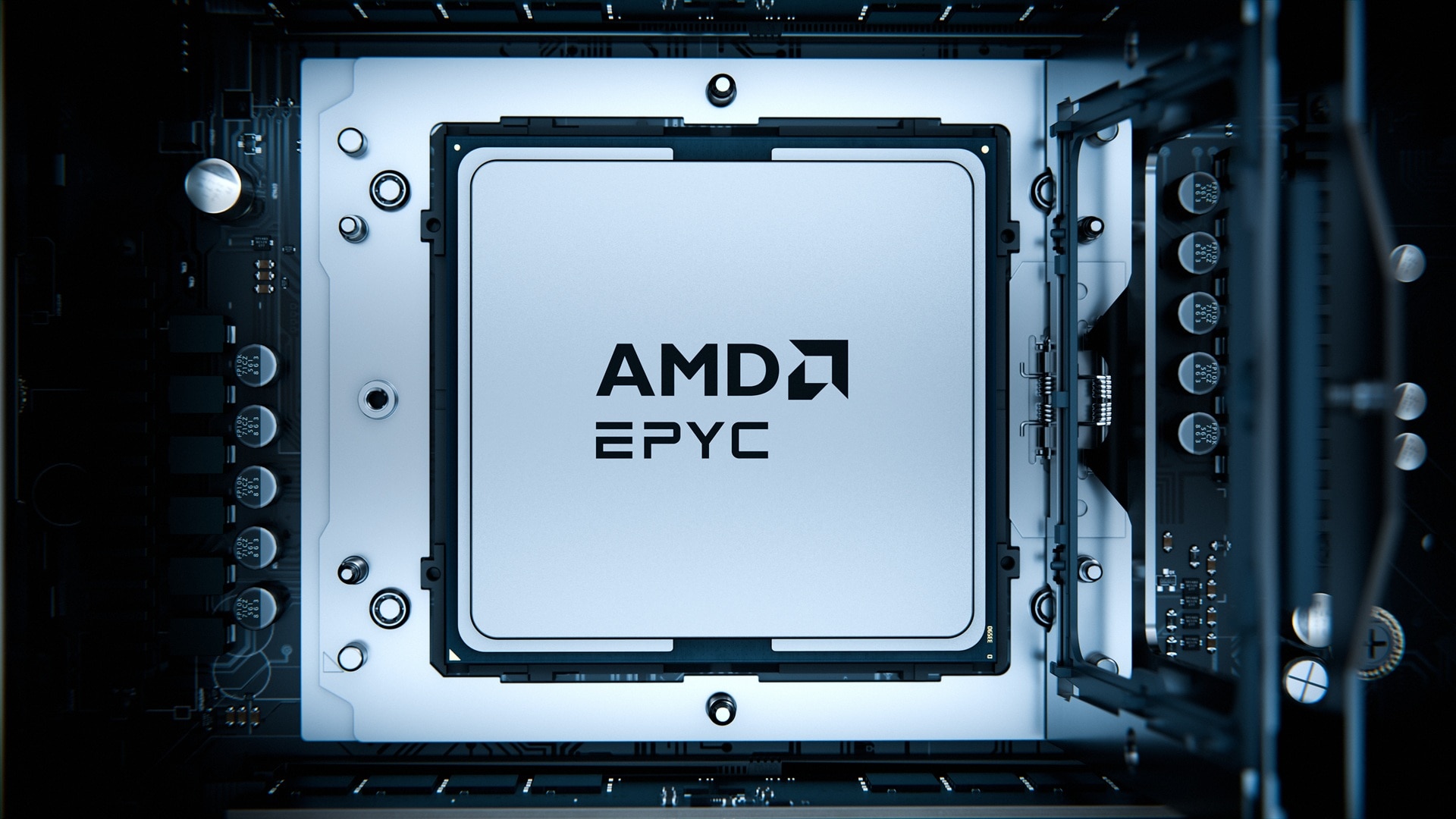
In SPECrate 2026 Integer testing, AMD says its EPYC 9996 delivers 1.2 times the per-core performance of a Vera-based platform and 2.24 times its platform-level performance. Across enterprise and cloud-native workloads (server-side Java, OpenSSL, MongoDB, Redis, NGINX, and TPC-C-style transaction processing) AMD reports gains of 2.4x to 3.7x over Nvidia's chip. The headline figure is a modeled 100-kilowatt rack: AMD says a rack built on Venice delivers an estimated 3.4 times the throughput of an equivalent Vera-based rack, up from the 2.37x AMD claimed for its current EPYC 9965 "Turin" against Vera back in June.
That June figure didn't just get a new chip added to it. AMD's rack-level number is a geometric mean across a workload set, and the new paper swaps SPECrate 2017 Integer for SPECrate 2026 Integer in that mix alongside server-side Java, NGINX, Redis, Memcached, and TPC-C. Recalculated on the new formula, AMD's own current-generation 9965 also moved, from 2.37x to about 2.3x against Vera. Venice's 3.4x is a fresh model run, not the old chart with an extra bar.
Estimates measured against estimates
None of this comes from AMD and Nvidia hardware sitting in the same rack. AMD's own footnotes describe the comparison as "preliminary performance estimates based on AMD engineering projections and subject to change," and the Vera side of the SPECrate 2026 numbers is sourced from Nvidia's own published Vera architecture white paper, not from AMD benchmarking a Vera system directly. Both companies are arguing from projected numbers for a matchup that hasn't shipped yet, which is a narrower claim than "AMD's new chip beats Nvidia's new chip."
AMD frames the comparison around rack-level deployable capacity rather than a single socket, on the reasoning that agentic AI workloads lean heavily on CPU-bound orchestration, databases, caching, and retrieval work surrounding the GPUs actually running inference. Venice, AMD says, is already in production, with OEM platforms on track to launch and cloud providers beginning deployment later this year. Vera is Nvidia's own next-generation CPU, built around an 88-core design Nvidia calls "Olympus," and has not shipped in volume either.
HotHardware, which first reported the revised figures, noted that Nvidia claims the win in its own testing, under its own choice of benchmarks and constraints, and that AMD's rack estimates model performance rather than measure two physical racks side by side. Reasonable, since a vendor's own model of a competitor's unreleased chip is not independent verification of either one. What the white paper actually shows is that AMD moved its own number by more than a full point inside three months by changing the ruler it used to measure it, which is worth knowing before the 3.4x figure shows up in a slide deck as settled fact. Independent benchmarks on shipping Venice and Vera hardware, run by someone with no stake in either result, are what would actually resolve the argument.
Sources
- AMD Newsroom: EPYC for the agentic AI stack — September 18, 2026
- HotHardware: AMD's revised EPYC vs. Vera claims — September 19, 2026