
NV1
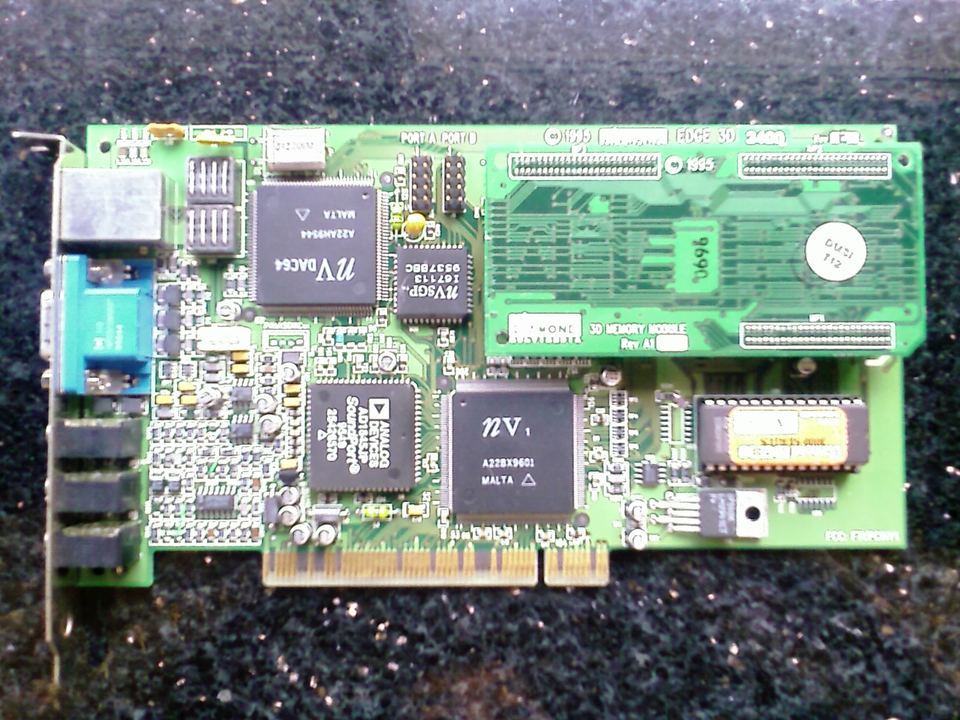
NVIDIA first-generation NV1 entry, useful mainly for documenting the pre-Direct3D triangle era and Diamond Edge 3D cards.
Key Metrics
- Launch Date
- 1995-05-22
- Memory
- 1 MB, 2 MB, or 4 MB depending on board FPM DRAM, EDO DRAM, or VRAM depending on board
- Memory Bandwidth
- About 0.4 to 0.48 GB/s
- TDP/TBP
- About 2 W class
- Interface
- PCI
- Process Node
- SGS-Thomson 500 nm class
Save this GPU, then open another GPU page to compare them side by side.
Or compare with:
GPU Gallery

Why It Mattered
NV1 deserves historical treatment because it was NVIDIA's first graphics product line, but it should be framed as an early multimedia accelerator rather than as a modern GeForce-style card. Source review should keep the NV1 and STG2000 naming clear and avoid treating later Direct3D-era assumptions as if they applied to this chip.
Launch Context
Source-reviewed notes should explain NV1 in the mid-1990s PC multimedia accelerator market, including the Diamond Edge 3D retail context only where sources support the exact product relationship.
Architecture Context
NV1 context should focus on its unusual quadratic texture mapping approach and early multimedia integration. This section needs careful sourcing because later triangle-based Direct3D hardware followed a different path.
Collector Relevance
Collector notes should focus on identifying complete Diamond Edge 3D-era hardware, bundled controllers, media, and driver disks only when supported by photos, manuals, or archive sources.
Used-Market Caution
Used-market notes should warn that practical testing depends on period-correct operating systems, drivers, game support, and bundled hardware. Do not imply broad modern compatibility without a source.
Known Issues
The quadratic rendering model limited compatibility with the APIs and games that became dominant. The all in one multimedia design also made boards expensive compared with simpler graphics cards.
Known Failure Points
The main failure mode is expectation mismatch. NV1 is not a normal late-1990s Direct3D accelerator, and compatibility depends heavily on period drivers, supported games, and the host operating system. Missing controller adapters or audio/gameport cabling also reduce practical usefulness.
Driver and Platform Notes
Driver and platform notes should be limited to source-reviewed period Windows and bundled software support. Modern driver support should be treated as unsupported unless a reliable compatibility source says otherwise.
No practical modern Linux 3D support.
Windows 95 era hardware. Later Windows support is not a practical target.
Compare with
STG-2000
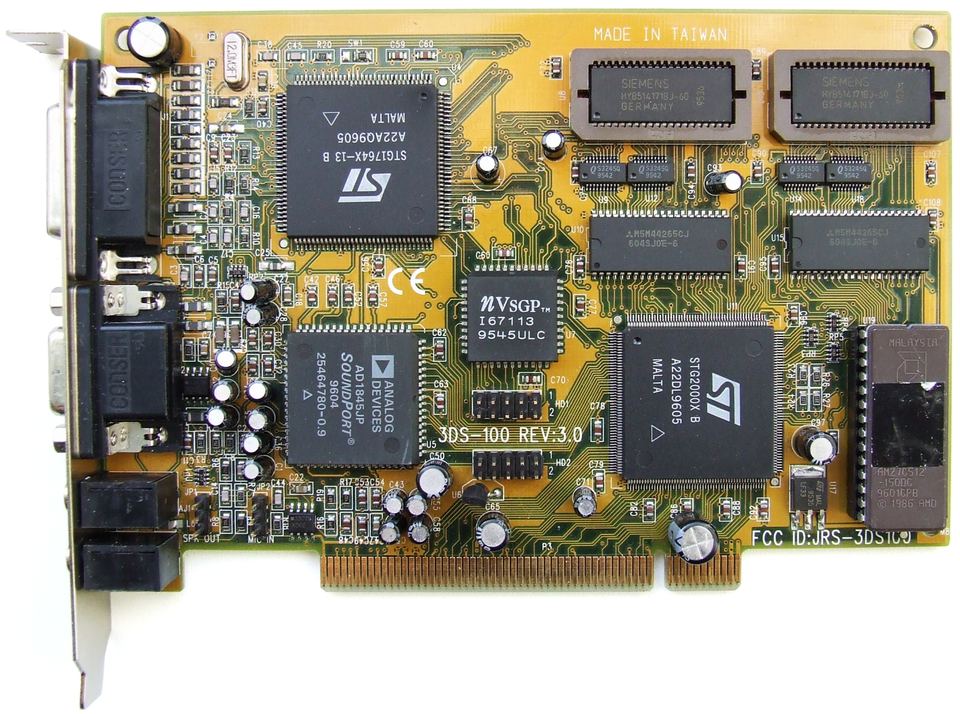
Early NV1-family STG-2000 reference entry, useful for separating chip identity from later RIVA and GeForce naming.
CMP 100HX-210
CMP 170HX 10 GB
CMP 170HX 8 GB
Sources
Primary / manufacturer sources
- NVIDIA NV1 announcement mirrorNVIDIA May 22, 1995 press release textOpen source
- Diamond Edge 3D referenceBoard-level memory, ports, price, and release contextOpen source
- NVIDIA's Quadratic Processor: The NV1Historical architecture contextOpen source
- IEEE Computer Society, Nvidia's Quadratic Processor, the NV1Historical reference for NV1/STG2000 context and quadratic rendering.Open source
- 86Box, NVIDIA emulation journey: RIVA 128 / NV3 architecture historyRetrospective technical context; use as secondary background, not primary launch evidence.Open source
Photo sources
- Wikimedia CommonsPhoto: Diamond Edge 3D 3400 NVIDIA NV1 PCI board (Front)Creator: HyinsCredit: Hyins / Wikimedia CommonsTitle: Diamond Edge 3D 3400License: Public domain (creator dedication on file page)Source claim: Commons preserves original photographer Hyins’ own-work Diamond Edge 3D 3400 upload and public domain dedication.Modified: Resized to 960 px maximum dimension and JPEG recompressed at quality 78; no crop.Board identity: The exact photographed example is identified on its Commons file page.Configuration: This is a Diamond Edge 3D 3400 partner board. The photo does not establish its memory capacity or memory technology among the Wiki NV1 options.Original file page