
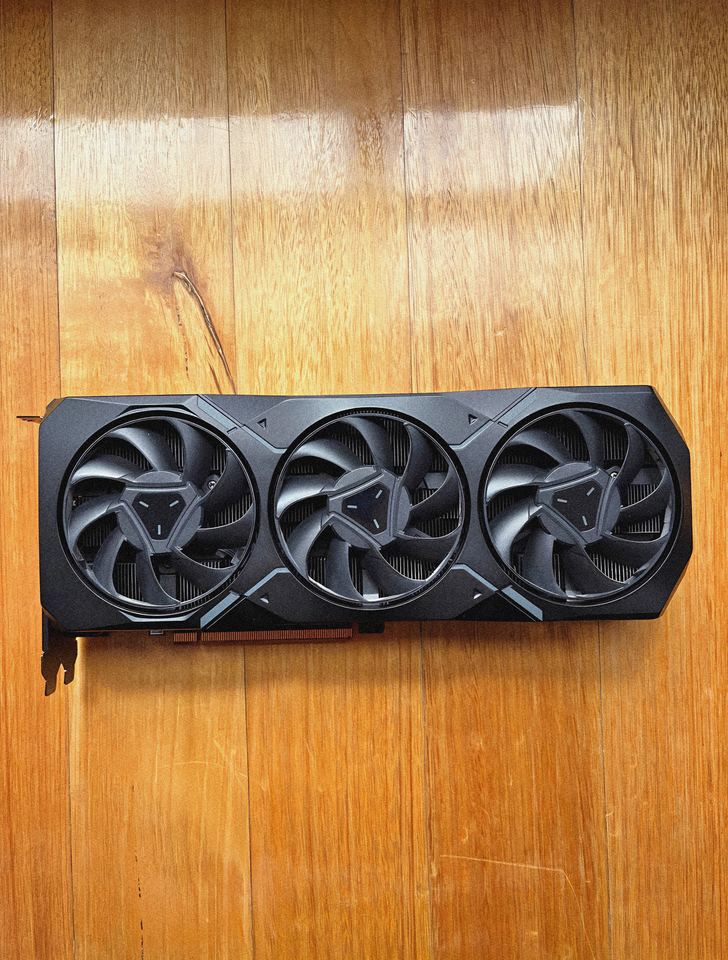
Radeon RX 7900 XT
Reference GPU
RDNA 3.02022
5,376 Stream Processors · 20 GB GDDR6 · 300 W
GPU Wiki Architecture
RDNA 3.0 (codenamed Navi 3x) launched in late 2022 as AMD's first chiplet-based consumer GPU generation, powering the Radeon RX 7000 series. It pairs a 5nm Graphics Compute Die (GCD) with separate 6nm Memory Cache Dies (MCD) that house the Infinity Cache, allowing AMD to mix process nodes for logic and cache on the same package.
The generation added second-generation Ray Accelerators, hardware AV1 encode via a dual Radeon Media Engine, and DisplayPort 2.1 support, while delivering improved performance per watt at the high end relative to RDNA 2.
Chiplet die design: first AMD consumer GPU built from multiple dies (GCD + MCD), mixing 5nm logic with 6nm cache dies.
Second-generation Infinity Cache distributed across MCDs, with smaller per-die capacity offset by the chiplet arrangement.
Second-generation Ray Accelerators with improved throughput over RDNA 2.
Hardware AV1 encode (dual engines on high-end models) and AV1 decode via Radeon Media Engine.
DisplayPort 2.1 support (up to 54 Gbps UHBR20) for 8K/4K high-refresh output.
FidelityFX Super Resolution 2 / 3 and Radeon Image Sharpening support.
DirectX 12 Ultimate compliance.
RDNA 3.0 marks AMD's transition to chiplet GPU design, a manufacturing approach that lets AMD combine different process nodes for logic and cache and scale die sizes more flexibly than a monolithic approach. While it did not surpass NVIDIA Ada Lovelace at the very top end, it delivered competitive rasterization performance across the mid-range and established the chiplet model that carried forward into RDNA 4.